David James Woo, PhD
I am a teacher, researcher, technologist, and speaker based in Hong Kong. My work sits at the intersection of classroom practice, English language education and AI in education.
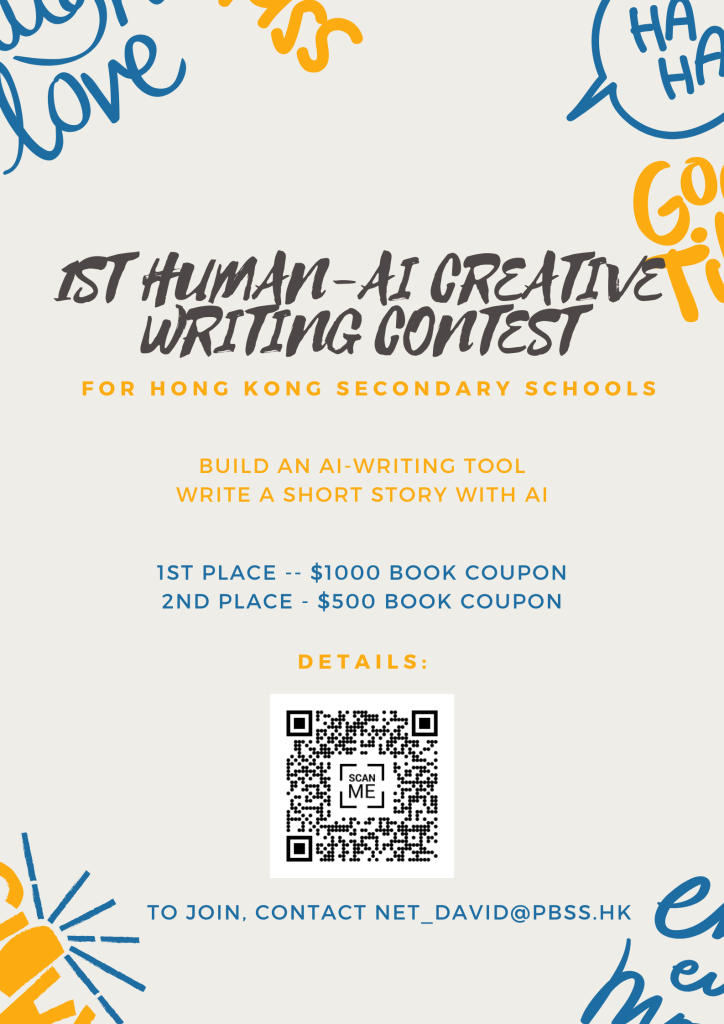
My work began in 2021 when I founded the annual Human-AI Creative Writing Contest for Hong Kong Secondary Schools. The purpose of the contest is to enhance students’ language learning and to give them a genuine, creative reason to use AI ethically.
Today I work with educators in schools, universities and other institutions. I co‑design curricula. I run workshops and am invited to speak. My output includes nine first-authored SSCI journal articles exploring how generative AI can support language learning.
EVERWRITE is my portfolio of work: the contests, the workshops and speaking engagements, the research and the practical resources I have developed alongside Hong Kong’s teachers and students.
If you share an interest in evidence‑based AI education, I would be glad to collaborate.
Dr David James Woo
PhD, MEd, PGDE (Hong Kong)
MPhil (Cambridge, UK)
BBA (Notre Dame, USA)

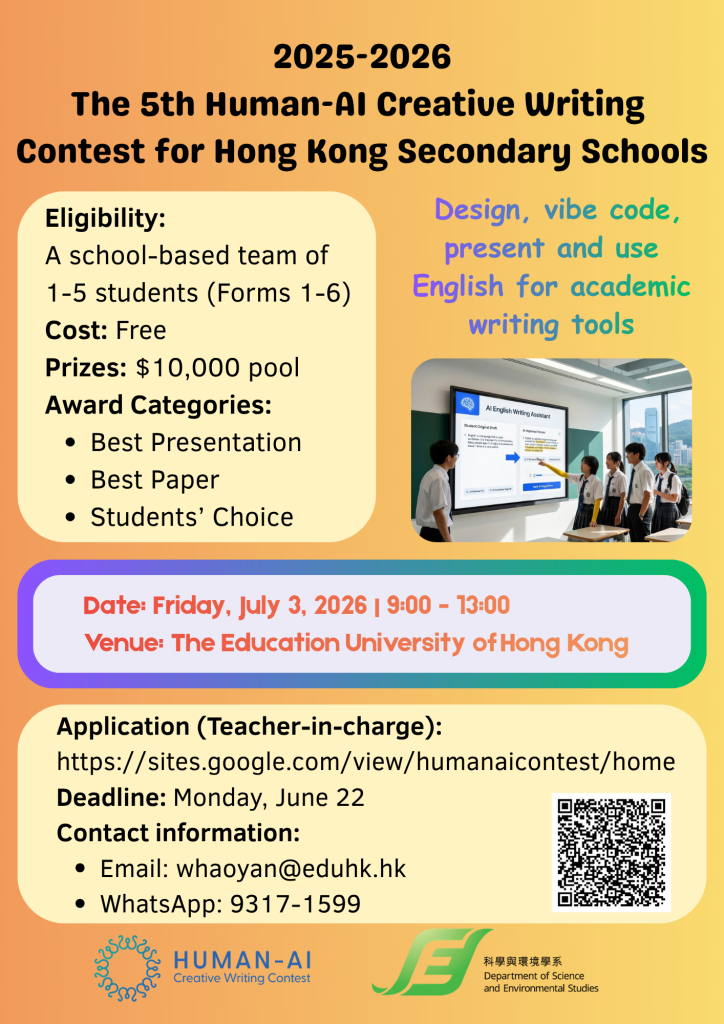
The 5th Human-AI Creative Writing Contest for Hong Kong Secondary Schools
The contest aims to enhance students’ competence to design, vibe code and present English learning apps for authentic English learning scenarios


Invited Talks and Workshops
Mapping AI automations and enhancements to history assignment workflows.
Woo, D. (2026, September 21). Doing Hong Kong History (HIST7008) Session 7, Department of History, University of Hong Kong.
Vibe Coding
Woo, D. (2026, March 26). English Panel Meeting, HKUGA Primary School.
Enhancing Student-centered Learning Experiences with Generative AI
Woo, D. (2026, March 25). Guest Lecture for LDTE3100 Design Thinking as Scientific Inquiry, Chinese University of Hong Kong.
Generative AI and Digital Tools to Support Process-oriented Writing
Woo, D. (2026, February 6). Guest Lecture for ELED4840 Language Assessment and Evaluation, Chinese University of Hong Kong.
Using Google NotebookLM as Automated Writing Evaluation (AWE) Software
Woo, D. (2025, November 14). HKUGA Primary School, School Professional Development Meeting, HKUGA Primary School.
Research Publications
2026. EFL Students’ Attitudes and Contradictions in a Machine-in-the-loop Writing Activity System
Woo, D., Susanto, H., & Guo, K. In T. Wang & T. Keane (Eds.), Artificial Intelligence and the Futures of Learning: Practices towards Quality and Inclusion. Springer. https://link.springer.com/chapter/10.1007/978-3-032-12174-5_19
2026. Developing English academic writing and AI literacy in an EFL co-curricular secondary school context
Woo, D., Kizilates, S., Guo, K., & Wang, D. Innovation in Language Learning and Teaching, 1–17. https://doi.org/10.1080/17501229.2026.2636962
2025. Effects of a prompt engineering intervention on undergraduate students’ AI self-efficacy, AI knowledge and prompt engineering ability: A mixed methods study
Woo, D. J., Wang, D., Yung, T. & Guo, K. British Educational Research Journal, 00, 1–28. https://doi.org/10.1002/berj.70087
2025. Comparing Hong Kong secondary school students’ perceptions of ChatGPT-assisted EFL writing
Woo, D. J., Wang, D., & Guo, K. The Journal of Educational Research, 1–21. https://doi.org/10.1080/00220671.2025.2525243
2025. EFL secondary students’ use of ChatGPT for writing task completion pathways
Woo, D. J., Guo, K., & Susanto, H. The Journal of Educational Research, 1–14. https://doi.org/10.1080/00220671.2025.2510382
Software Applications
Animal Farm Interactive Website
For Grade 8 students preparing for the literature final exam. Digitizes the full Animal Farm book, circulated materials, notes, and practice essay questions. Features character‑based live audio chatbots, automated writing evaluation, gamification with leaderboard, and a teacher dashboard.
https://animal-farm-website-gamma.vercel.app/
BookPrint
To promote reading to Hong Kong secondary school students: a book recommendation system based on student input and Dr Woo’s reading list from 2006 onwards, comprising hundreds of books.
https://bookprint-drwoo.vercel.app
English Reading & Usage Interactive Website
For Grade 8 students preparing for the final year exam. Features vocabulary exercises, phrasal verb worksheets, question tag exercises, AI‑generated reading passages with comprehension questions, and AI‑generated grammar questions. Includes a leaderboard and teacher dashboard.
https://g8-fye-practice.vercel.app/
Literature Anthology Interactive Website
For Grade 8 students self‑studying for the mid‑term test. Digitizes the literature anthology booklet and includes examples from the first five chapters of George Orwell’s Animal Farm.
https://aycxtruc66lds.ok.kimi.link/
Oral Exam Practice Website
For Grade 8 students simulating the oral exam. Provides 3 minutes of planning time, a text input box for note‑taking (with skip option), and two minutes of near‑simultaneous conversation with a human‑like voice. Students can choose a topic, select a partner by proficiency level, and receive AI‑generated feedback based on the marking scheme (with a clear disclaimer). Transcripts can be downloaded.
https://g8-oral-exam-practice-655197796551.us-west2.run.app/
Wonder Study Interactive Website
For Grade 7 students self‑studying for the literature final exam. Includes character‑based chatbots, automated writing evaluation, gamification with leaderboard, and a teacher dashboard.